Cein Ād’belōr, the Nameless Ruin
The Dark Harbinger, Edge of Erosene, Star Eater, Eclipse of the World, Worldcutter, Great Torrential, Sire of Ferrons
Class:
Mandragora
Size Rank:
Eschaton
Generation:
First
Link:
Unfettered
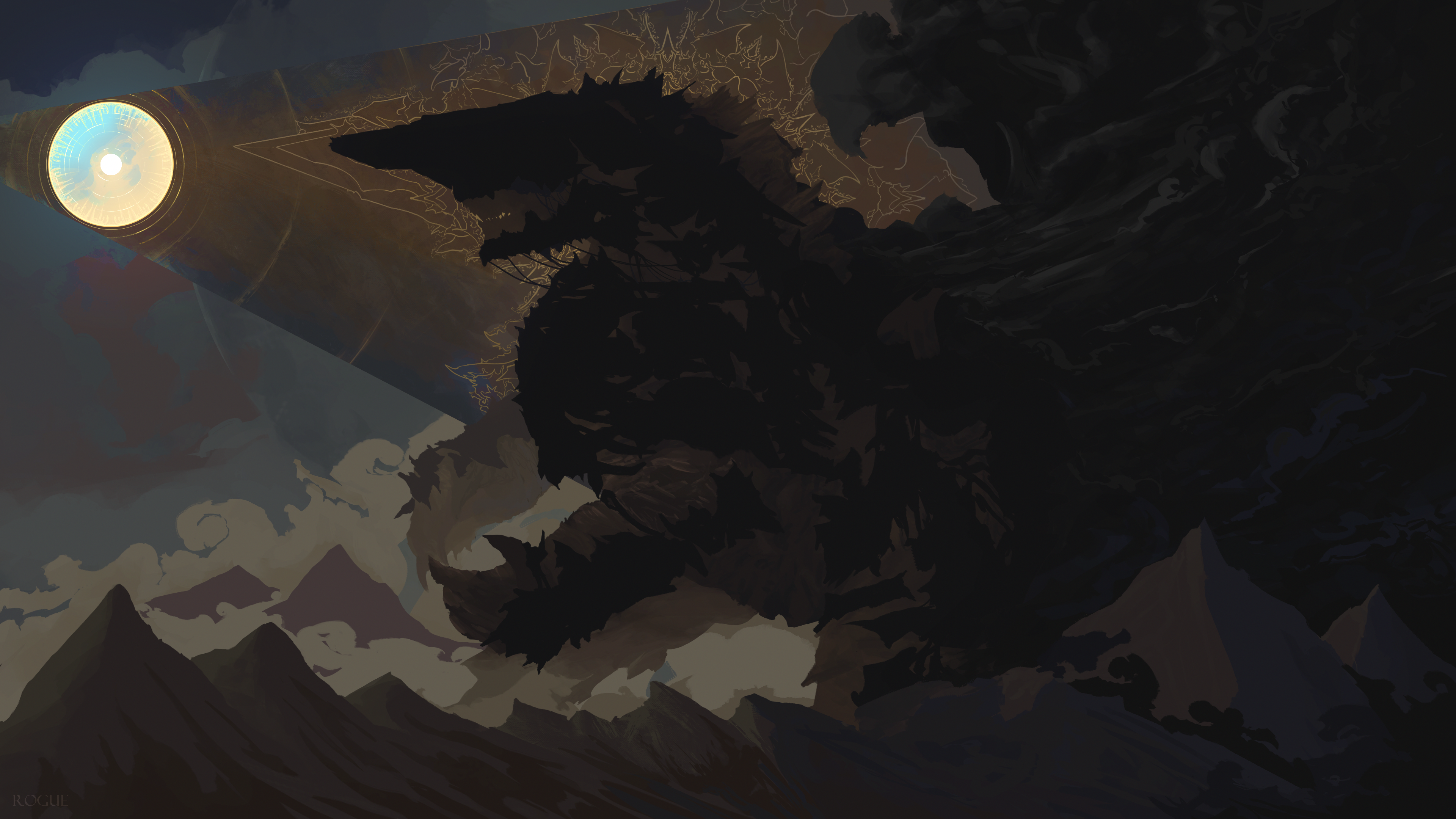
The Nameless Ruin, born with the name Cein Ād’belōr (meaning “Great Below”), is the child of the second highruler, Lord As'deghorath, the precursor of the semi-ratenous beings (of neither true birth nor among the lesser category), and the Harbinger of Erosene, or the End Times for all humanity and mortal kind. It is depicted as a six-legged mass of monstrous proportions rivaling mountains, whose passage sunders the deep earth and swallows the fiercest of storms. It is unclear the true sizing of the beast, with texts describing it rivaling the mountainous amenoths, while others describe it dwarfing them, and some posing all of the above as exaggerations. Although mistaken as a ferron, the terror is a mandragora (noted as the first mandragoran) which carries upon its body the Valus Worldcutter, an immense and emburdening form of armor forged by the realmic daemons as both safety and sentence. The Valus Worldcutter is always depicted along with Cein Ād’belōr, and is what lends to the beast’s mast-like head and stern-like body.
(For information of prophecy, see below)
Sometime within the Age of Solset, it was believed that a brief period of ethereal but unyielding darkness manifested and claimed a significant portion of the World’s surface, effectively dividing all life and land between two halves upon the Sunlands. This event was known as the Black Eclipse, or the God-wall, in reference to its linear, wall-like shape, and it allowed a brief period called the Age of the Schism in which the demons of the Realm could reign terror wherever the God-wall stretched. At the time, no being was thought capable of summoning such a catastrophe—save one, whose name was not spoken, and whose shadow already laid across the world before: the Dark Harbinger. It is believed that the Age of the Schism—though spanning four centuries—was but a test by the realmic Lord to gauge both the power of the then young beast and the aftermath that would ensue in the wake of its path. Such theories are only supported with the notion that the Age of the Schism only occurred once, and no more.
The name Cein Ād’belōr originates in likeness to an older power, a god spoken of in fragments older than the daemons themselves, and which drove them to inhabit the Realm. It ruled over an era with no crown, but as a presence in likeness to a divine being, and was given the name Cein Ād’chasor the Unreachable. Though never fully accounted for nor explored, the god is described as bearing ‘burning hands and an eternal veil, with a Worldly body of white.’ Both omnipotent and omnipresent, its rule has no documented history, for nothing that endured its time remained to bear witness to it directly, but only in reference. In rebellion to its power, Cein Ād’belōr was created in defiance against the Unreachable, and was fashioned to bear the armored mantle against its wrath and reign. What followed is left to inference, for it is said that the beast was not meant merely as a shield for the World, but to endure the god’s presence and power—and, in time, to subdue it—and take away its sway of influence so that the very skies and the residents of the Realm may no longer be at any god’s mercy.
In myth, Cein Ād’belōr is thought to be born a dragon, however, no hexapedal beasts, like regal dragons, were known to exist at this time. Instead, the Lord of the Realm and their power perfected the beast’s body through rituals and rites to better fit their goal. These rituals were described as involving a selected group of powerful daemons, called Erticiples, along with the Lord, with a massive collective effort to mystically reshape and biologically engineer the creature to better fulfill its destiny. A verse of the Book of Annalaid, from the Chapter of Revelations:
"A gale shrilled—battered against the confines of their hidden World. From atop their warm calcified remains of Old, and from below the shell of the heart’s head. Within the chamber of Garsummons, one spoke clear; Lord, the ferocious Sovereign, spoke, and the highdrove bowed. For first their Might said to take the chaos which whirled behind its core, beneath the heart. It was weak. Too unruly, and would never attain the genesis of guidance, as those stellar eyes that burned them. For the Lord knew that in chaos was its power not in its destruction, but in its eternality.
The highdrove bowed, and in Will they made it so.
Next was its crown of ceratin and ivory. Sharp and regal it may be, even far spread it could not transgress the worldier touch of presence. They listened and bowed once more. He spoke, and sought to take away its finite pride. In body, it was trapped. Too contained and forever imprisoned, it would never gain the perfect form necessary to encroach within their realm of Unreachable. For the Lord knew that in pride was its hunger inspired not in purpose, but in promise.
The highdrove bowed, and in Will they made it so.
Opening wounds, prying soul-filament, shifting body, rewriting myst—the Eirticiples convocation survived even through war. And when they asked where the power of chaos would be kept, and where its hunger of pride would be hailed from, their Lord spoke again in but a single word: behold."
Detailed to have taken the Lord and Eirticiples nearly a calendar year before they succeeded, there were many changes to Cein Ād’belōr’s making, such as a hellishly hyperdontic maw, scabrously jagged and impenetrable skin, and most crucially: a ‘stolen breath and cleft pride.’ The two latter specifiers, detailed in the Tome of Revelations, being a focal point to the Ruin’s role, wherein the Eirticiples took away its breath and harnessed it into an artifact, and the Lord took its pride (or wings), illuminated within a duel between those two which lasted for a lustrum and caused significant destruction and hallowing. While it is thought the Lord’s decision was made for the fact that they would be repurposed as midlegs that would support its enormity, the Tome reveals it was rather a vow inspired by the mythical mandragorans; massive, regal creatures of the deep Realm, they terrorized the realmic daemons for all their time there, and in this ritual would they be conquered beneath the shadow of their making. Unknowingly, this is also thought to be the origin of all hexapedal beasts, as the six limbs would soon become a major evolutionary milestone for later descendants, of which follow from the Nameless Ruin.
After the near-pyrrhic victory, Lord As'deghorath drew his blade and severed the creature’s wings, and carved a massive wound along the ridge of its back. The process of the spar and effort it took to perfect this single swing resulted in the permanent maiming of his arms, yet there, the Eirticiples stowed its breath, but not before accursing it with their most infernal binds, a process which also resulted in their near-extinction. Repurposed, the creature’s breath endlessly released from the Lord’s scar. Wherever it walked, a World encumbering darkness followed; a darkness filled with an accursed myst capable of degrading all life and living, and absorbing the light of the sun, giving it extremely pernicious properties. Thus, within archives, versus, and stories told, its presence became less a name than an omen. Dread followed the beast through all tellings, one akin to one of the Great Sorrows, and within it mortals found a reflection of their own helplessness. This alone gave a fear enough that many would not speak its name, and thus, the title Nameless Ruin followed in spite of it.
In prophecy, myth, stories and fears do they share a commonality: that Cein Ād’belōr represents inevitability, and the misery it entails in its wake. Sometime in the far-future, the beast would reawaken, and in its return would arouse another God-wall—but unlike before, one more true. Not as a test, but in its full and final making to bring about the final era.
The Prophecy of Ruin
From an Unknown Seer about the lost chapter of Finality:
Dread the day Man will know nothing. Afore the day the Sorrows come and prepare sons and daughters, they will speak of a Week of Ends, six days that unmake the World. Each bears their appointed ruin, like a pillar felling beneath an ugly ivory tower. Greatest of these, ye sufferer, is the seventh day—and none will hear the heavens fall, the hells rise, the seas crash, nor the World upend. Man will not know what comes, try as they may search for it; he shall seek the wound, but find himself; he shall blame the offender, but find none. And with no cause, he will not know why.
Until the earth opens.
Then shall the storms join hands, and all their names be made in one. The Sorrows and their sufferers will know the days on forwards. First shall the winds lay their breath, their ancient course forgotten, and bow their bodies against the coming. They shall strive against it, but futile their struggle lay, and power wane, and purpose end. Thereafter, a silence subsumes not born of peace, but of surrender. In their submission shall the wilds sense what is hidden from Man: and the birdfolk will abandon the heavens, therials abandon dominion, and the scaled shall slip from the World.
The earth reckons beneath a slow thumping—likened to a stalled, even heartbeat—and grows and grows unto a trembling. Great Nature will fall and go first, then their realm of stay; no mountain, even mighty and grand, shall save face and keep their heads aloft. The thunders will rage, but know not any familiar groundskeeping again.
—And the Great Torrential, the Nameless Ruin, whom Death rides as steed, shall never raise his terrible head, nor let know the way to his dreadful bellow, but wear the mantle of his role in earnest, for in his shadow a Mother Veil—great God-wall—ariseth. Beneath winged-hands infinite and inescapable, the wretched flood of bones and blood begin. Harpies, heart-stealers, mired and man-killers, fire-kissed and skin-scorched, hulks and hallow-kin arise from his wake, and take all sacredness away from Man—of he who wept in terror, froze in fear, or laid to rest afore their home and family, until there is nothing more. And Man will see nothing—that no bravery and no dread matter now—and know no miracle and no mercy alive now. And the World would drown in an unerasable darkness. Man will know nothing. Nothing, ye sufferer, nothing will remain, and all Gods, thee mighty, will rule amidst an empty, dead throne.