Arabas
The Hinwolf, Greatwolf, the Arbiter, Guiding Star, the First, First Worldwalker, Protector of Ardor, Light of all Swords, Sunbringer, the Unbreakable, Knight’s Compass, Bane of Shadow
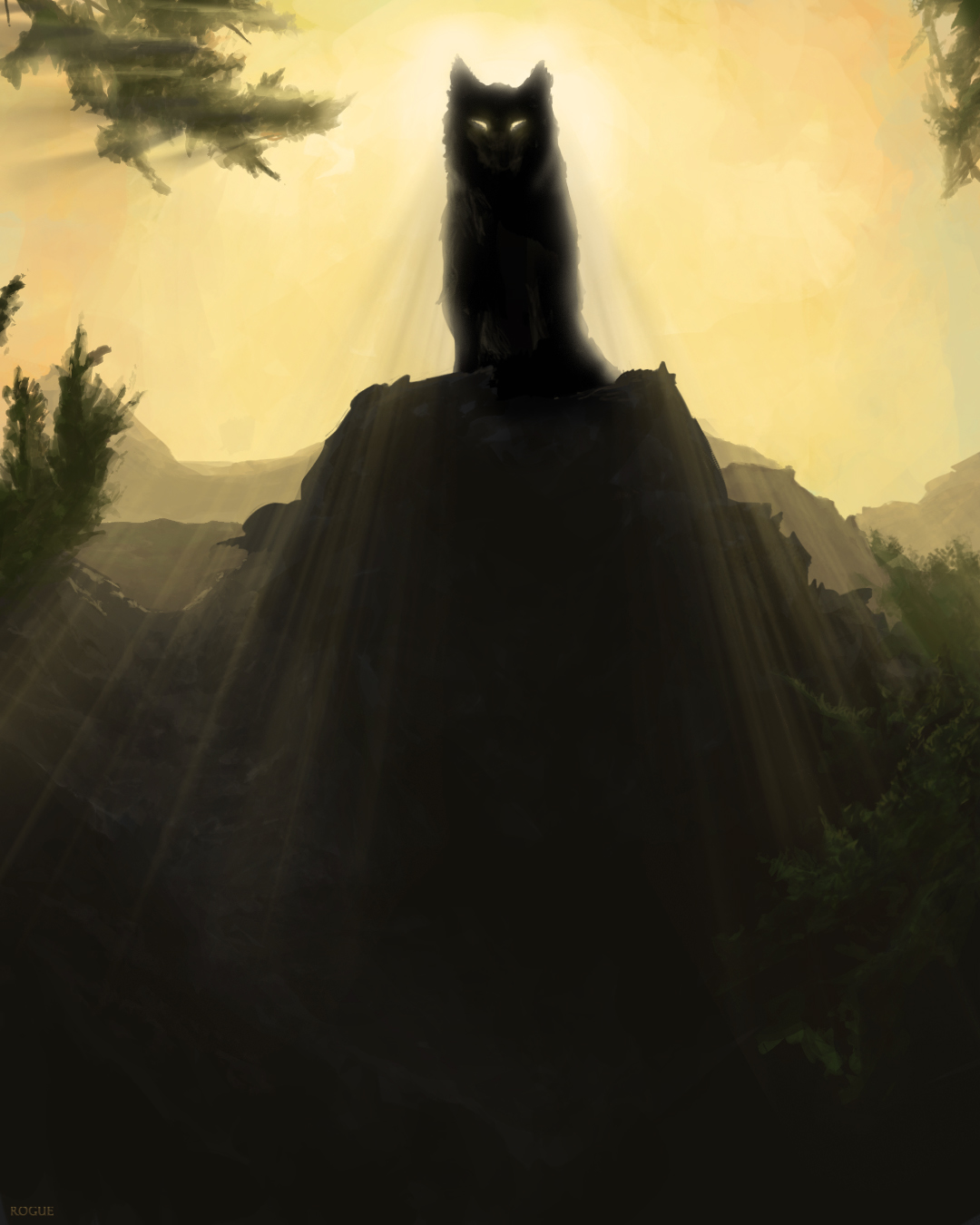
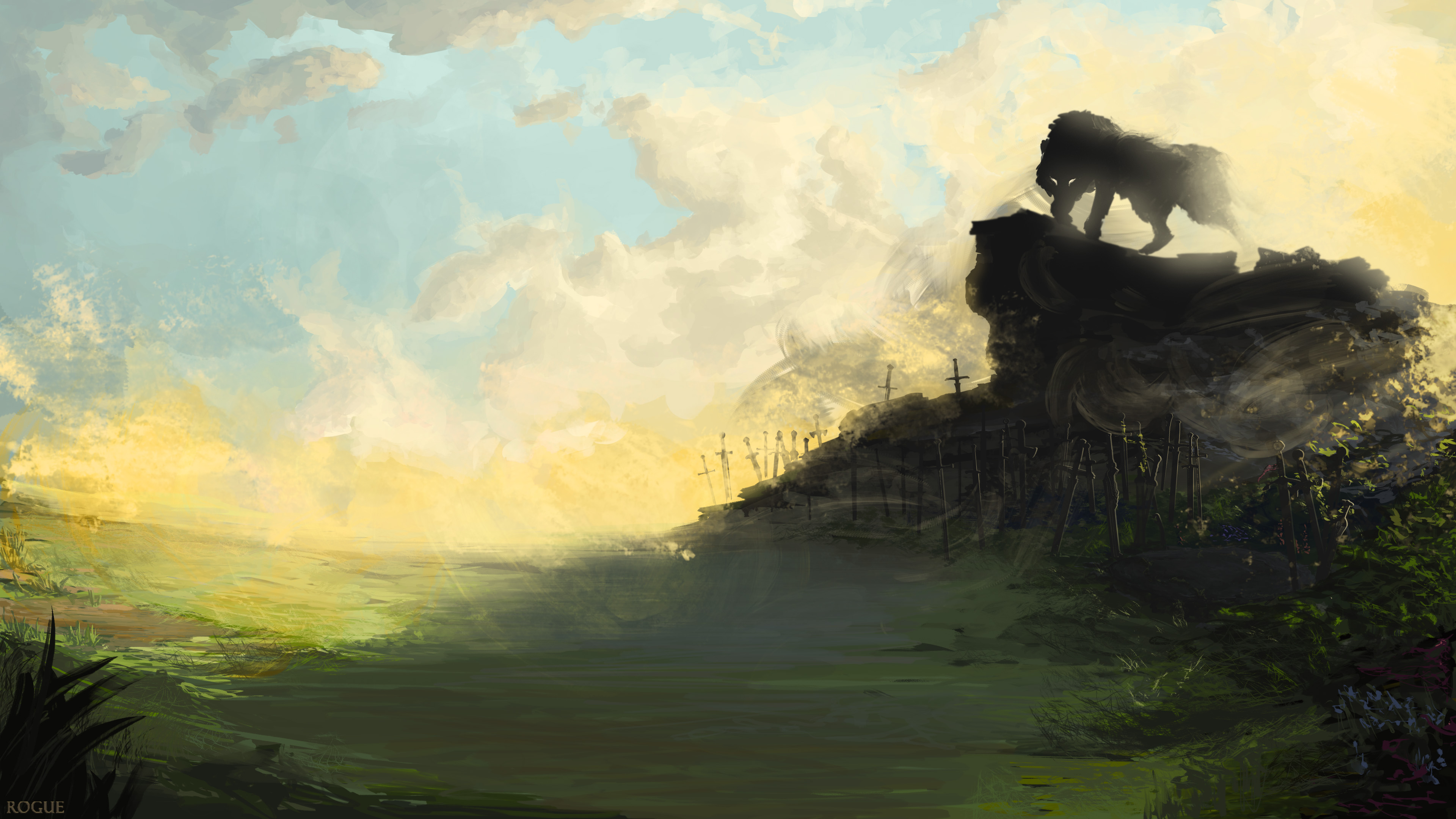
Arbitus, or more formally known as Arabas, is the first of the three primaries to humanity. He is the first among the children of the Hearthcity Aldin Arae, first among them and mortalkind alike to have wandered the World’s expanse, the guardian of warfare and nemesis of the Vile, and the highest authority to divine virtue. In some lights depicted as whole as having the shape of man, he is most often represented as a great-wolf with a coat carrying the darkest shade of night, and a body so mighty he may reach further than the light of stars. The Hinwolf presumes across different heavens as well as the different paths within them, guiding fallen warriors, knights, and others faithful onto their last, unfinished promises.
There are various postulations of the intentions that Arabas harbors for both the World and all beings within it; that within the constant depictions of battle and struggle, the Greatwolf prepares others for Erosene (the great prophesied doom), or that as the First Dawn unfolded, he continues to aim to rid of the Vile of the world, including the vicious divines. Nothing is unanimously held among them. Many stories are told of both his aid and hindrances among other beings and their intentions, which is at worst summarized as a capricious enigma, and at best an all-seeing guardian, and one who is particularly peerless and matchless in opposition. He enlists no followers, commands none under the heavenly skies, but instead acts solitarily—visiting various realms of other beings in some implicit and vague cause. Aside from capability, Arabas is the first of the ideals to have fallen from piece from the great Vessel. Due to this, the Hinwolf inherited the most emburdening fragment of his predecessor’s body: his raison d'être. A fragment which has stood to be the most potent phenomena that goes against the Great Enemies—to that of all things and all kinds. Like the Vessel, Arabas endeavored to roam the then Llys Apeiron despite its dangers and woes. He was first to taste his enflowering blood, and the first to fall to the shades of the land, though never fully. He had found many wonders and even more wiles within the World, however, the fragment of conviction empowered and immortalised him, and allowed for his vigor to inspire others. From this, the Greatwolf bestowed his own gift to the mortalkind: that which nearly every warrior, fighter, serviceman or woman abides themselves to, something deeper than mere law or edict; that which beneath citadels and under spires lays a material harder than stone and stronger than iron—within every sword and helm is sharper than steel and more reliable than cover. A bond stronger than myst, forged in promise, and written in spirit.
Conviction
Both one of the most powerful and dreaded aspects of mortalkind is the strength to persevere. Not to be mistaken with baser drive or instinct, the gift of conviction is higher, more complicated to an individual and their place in their journey. It can take many forms and adopt many colors; a priest to his faith, a child to their belief, or knight to their hope. It can manifest within the first step towards an uncertain destination, or present itself as the very conclusion to it within arm’s reach. It can empower and ward away even the greatest of sorrows—slay the foulest of enemies, and everpresent does its light warm where it exists. However, no matter how great or grand the light is, it can blind if bright enough—and burn if hot enough. Often it is too late when it has led astray the mind towards an opposite path. If not a double-edged sword, mercy to he who points his own brand to his heart.
Honor
It is wise for the benefits of good to never convince a heart that is where its home is. Like a binding, there are constraints necessary to guide safe practice from the gift of conviction so that it may never take more than what it gives. Discipline is first spoken to a boy before he swings a sword. Restraint is taught to the man before he wields his word. A king is instilled with principle before he brings naysayers to kneel. Mortalkind has learned this ritual, man and beast alike. But like water to fire, it can drown—even smother the flame and pull from the right-hearted into dark depths to silence those from their purpose before they bloom, or make inflexible and quixotic those too far gone. It convinces the heart that choosing it is what’s best. But instead, in the far future, those forsaken are left to a lonely cold: that sometimes the hardest choices are the ones that were never made.
Humility
The commonality between the warmth of conviction’s fight and cold of honor’s restraint is their place of home. Humility is the characteristic that gives worth to them, what begins before them, and what follows after. Without it, conviction is rabid pugnacity, and honor is baseless vanity. Unlike the former two, it harbors no light, no warmth, nor constraint, and does not take more than what is given—only what is owed. It seeks not malice nor sorrow within the heart, but that which is undeserved. The equilibrium between the aspects within the lens of it demand a mastery, dexterity, and capability—but within the journey ahead, it sharpens from the passage of time. It is not strength that makes a warrior deadly; not fervency that makes a priest rousing, nor technique that immortalizes a knight. It is the humility that each heed to themselves, and what they make of it. There is no master but one who knows what he cannot do.
Like his presence had once visited and explored, the benisons of Arabas live nearly in all faces of the World, including the Realm. He is the beating heart within bodies of citadels, the inspirator for conscriptions which arise between era to era seeking for those who will answer their own inner call. No struggle of a countryman or journey of a knight’s wanderment is devoid of his ideal. As it is told, the most notable of his achievements was the advent of the sun, which he had explored the endless night of Llys Apeiron in the First Dawn, fetched from the heavens, and returned with. In some cultures, the wolf is held as a sacred creature, and is given offerings in reverence. Rarely is dissidence ever accompanying Arabas, except for those who see not the virtuousness, but viciousness of his aspects. It is not the inspiration which is problematic, but the consequence of it. War and battle share equally in casualty among its participants, no matter pact, promise, or spirit. But unlike the nature of the Grand Fury, Immirus, the Hinwolf’s relation to warfare is not temporal as it is spiritual—nor does it reward with pride. Equally so, not always does faith remain constant and unchanging. It is breakable, corruptible, taintable, and brutal in many more ways than one—and even innocent can it demand sacrifice. As it is said, faith is never lost, but misplaced. The constant turmoil of the mind between hope and despair is as old as time, and is illustrated between the numerous struggles of himself and the Keeper Meyiscin, who revels in the dread of despondency and decay. Additionally, making one of the points to one of the triangular chains of civilization, Arabas’ priority can become uncooperative and irrepressible to the other two points: of the Allcrown Melthild Khyne, and Immirus. Either beneficial or detrimental, a person’s belief is a war in and of itself, and can shift away from—or fight against—the craving for power, or the drive for control. Regardless, it is an endless push and pull onward within all souls of the World. Be it wealth, kith, kin, spirit, or body, it is the fight that the Hinwolf himself once did—and still does—despite any measure of barrier, burden, or uncertainty that lays ahead.