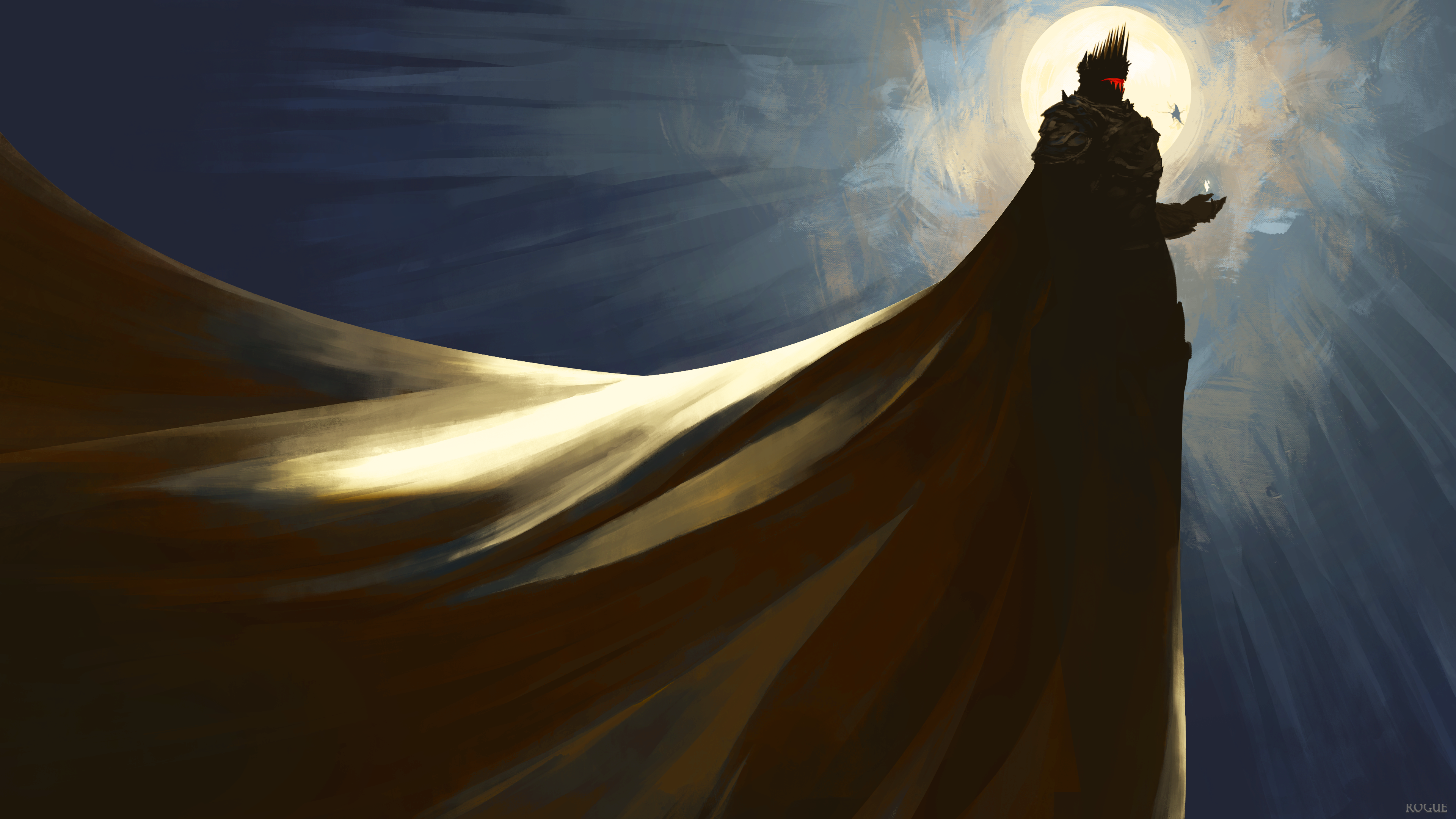
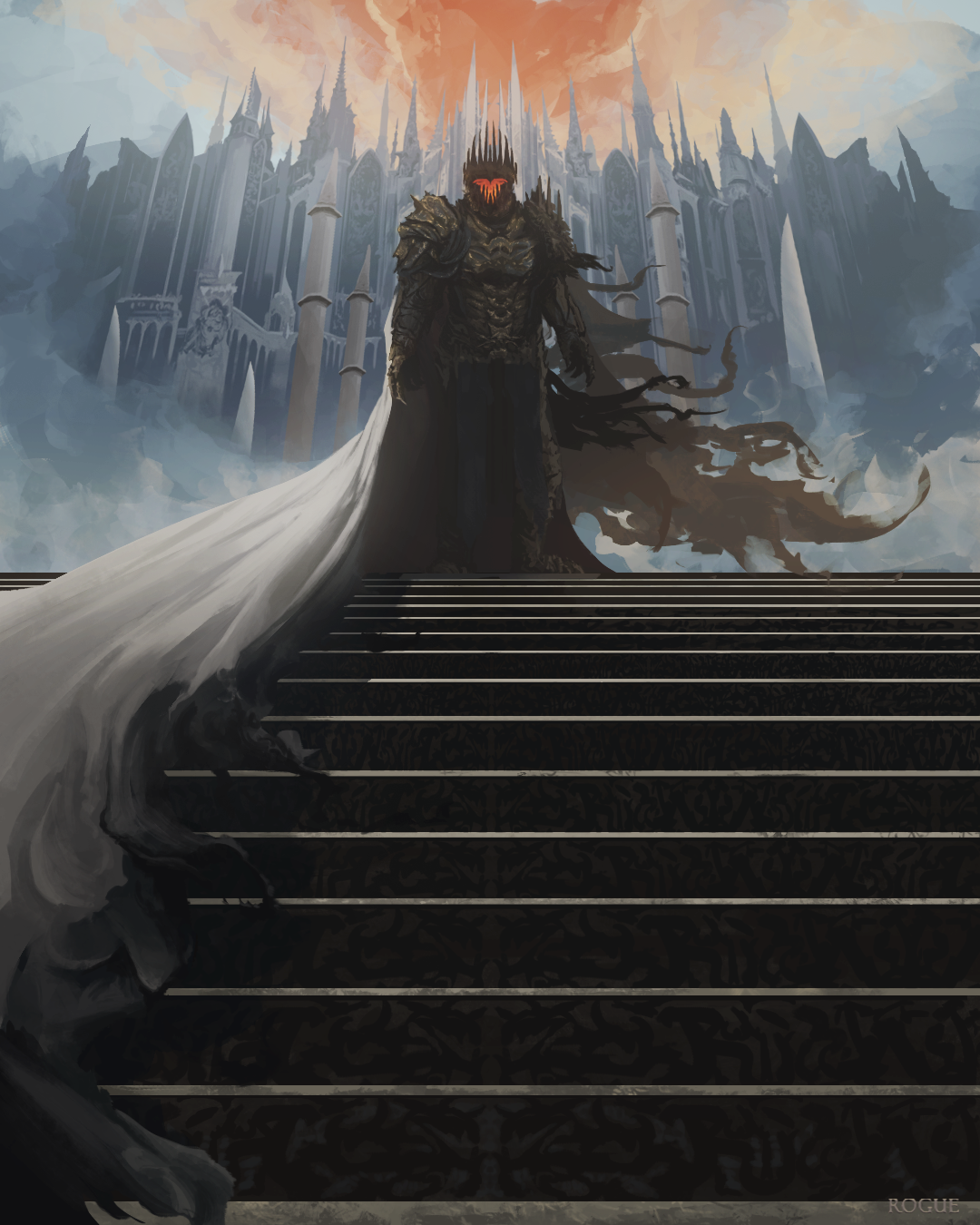
Melthild Khyne
The Allcrown, Sacred Father, the Ur-king, King of Kings, the Progenitor, Guardian Lord, Guide of Hunger, the Will Master, Lord of Legacy, King of the Hidden Kingdom
“I am War—of all its reasons to be and be made. Its progenitor, and its result together. The eternality that precedes it, and the age that succeeds it. Its boons and its consequence, and its call for its extinction. Of all its beginning and origin, and so too its vacancy and conclusion. I am the constancy that bears a will of which all follow, unto their birth—and until their final death.”
One to three of the contrivertable, Melthild Khyne, born of the two halves between the same namesake and his consort Haruel Khyne, is the sovereign ruler of the Hidden Kingdom, the former and first ruler to the Hearthcity Aldin Arae, and the axis convene to the World’s Will’s currents. He is of semi-mortality, being amongst only one of the ideals to renounce and regain his status of power and fully ascend remarkably by his own doing—although it is unclear how. Of divine likeness to the other aspects and their godhood, he takes shape within a domain known as Morhe Bilsethis, an immense and veiled city within a fracture above the Olden Lands. There, he both guides the nature of living men and provides auspices to those in the sway of the afterlife.
Uniquely, Melthild Khyne is regarded to be one of the sole beings who has mastered (at least most) the game of Will, an eternal and paracausal form of power—and its struggling participants—that alters the stream of want and desire, and, ultimately: fate. Though chaotic and entropic, he commands and exists with an abundance of that Will, and all that it alters in its wake. Wherever his presence is, so too is the order of inconstant, elastic—yet predictable, measured, and controlled change. Due to this, he commands great repute with many others of the divine, and is also revered by few within the Realm, with some inference that Aourcore, a realmic numen, takes in likeness to him, and may very well be him. The new-world revelation of the process and practice of Convergence, a method of mystical coronation which alters and enhances a monarch or royal leader, is said to have originated by his teaching within the First Dawn; some account that within the process, he takes form in dreams and visions, giving grace to those called to rule. What is more well known, however, is the belief that he is the maker of humanity, both physically and metaphorically. It was his hand in the giving of the Great Gift, a day within the Dawns that involved Melthild Khyne endowing the first of mankind with want, will, and desire, an action that still currently dictates the present Third Dawn. Being the surrogate father to humanity, he is able to bend the hearts of men and beings directly—and exceedingly stronger than any other aspect—to enliven them to their desires and ultimate ambitions, as well as maintain a degree of order and hierarchy within those hearts. He also oversees the Nine Archons, or the empyrean servants which bless and give Divine Rule to the major powers that exist currently. Empires and kingdoms rise and fall within his shadow, and tapestries unfurl to see the light of day at any whim of his. As such, he is an amalgam representation of the pinnacle crown (as the title Allcrown suggests), its stigmatized and charged torrent that is the guiding star, and the ladder of hierarchy itself for all that fall and exist below it.
Subjugation
Wielded by his hand, the role of the Allcrown places Melthild Khyne a representative of the quality of leadership, and its inevitable form of being. Kingdoms thrive under rule, of both maxim and majesty. Yet, not always is that quality pure and just, and not always is that state alive and satisfied. Tyranny can take many forms, of different subtleties and varieties. Sometimes it is oppressive, often dominating, or aggressive—no matter how defiant or differing the lesser order may wish to be. Others, it may be meticulous, deliberate and intended. Adjacent, it can be systemizing to an anarchic ecosystem, beneficial to a peculiar point or axis, and protective against the horrors of chaotic sorrow. Only a few beings of the World are barred from the constancy of sovereignty, and almost all are victim to it. There is a true chaos that is warded by guardianship, that which inhabits the dark, vast Unknown. The commonality between both is the certainty for the desire for control. It is forceful, yet, can offer a guiding comfort that abates the terror of absurdity.
Control
And thus materializes from his body the principle foundation that is both born, and births the former: that within the lives of the lesser order, those of the higher order—and any in between, the sway of self-governance is unavoidable, unerasable, and undeniable. All sentience yearns to know, to understand, and requires a cognizance of recognition. It was as the aspects, including Melthild Khyne himself, had learned for each of their Great Enemies, and, by extension, humankind’s own lesson. Hearts of lives fear what they cannot understand, and hate what they cannot find courage in. So, the pursuit of control offers a measure of liberty, but so too opens a pit of anxiety. The dynamism within this autonomy uncovers an endless path filled with promising results of all manner of good. If left unfettered, however, the gradual temptation of the notion can become all-consuming; that control can be found in all places that the self and mind wanders to, and that it should be the lens which offers the senses the ability to operate totally. An error requires correction—a crime, a consequence—and a goal, an objective. In this, the Guide of Hunger predisposes that all is conquerable—even the self, and prolongs the battle for the Eternal Endeavor.
Appetency
From within his shadow which is most prominent, even before the quality of leadership and the principle of the Eternal Endeavor, is perhaps both the most wretched and blessed quality that humankind has ever been born with: want; yearning, desire, craving, both desiderium and desideratum, and all else it takes form in—that which takes name as the Great Gift. It is a preeminent flame even before aspiration, and unlike it, is baser, vital, inherent and cardinal. One that can illuminate darkness, but so too abandon light. It can devolve and malform all the more to a more primal yearning, one that subjects the mind to mere instinctual whims. However, there is no worse enemy than that of yourself beholden to nothingness. That which ennui thrives with, leaving nothing but fading wishes and haunting voids of oughts, mights, and mays. Contentment is complacency. It sabotages the adoration that wonder is born with, and stagnates a tapestry of achievement. There are cruelties worse than death that prey on stillness, hopelessness, and beyond all else: resignation. The Great Gift ensures that we never lose our spark, and that our hunger will never fade, never wane, and never end. So long as we take them of our own volition, neither our fights and battles, and never our dreams and nightmares that inspire and embolden our destination.
Melthild Khyne’s direct association with the traditions of coronation, succession, and accession leave him inseparable within matters of the court and governing bodies, and even in urban culture. The tradition of Convergence and the process of the passing scriptures are said to contain allusions and direct calls to his name, while the texts involved, the Edicts of Anointment, carry verses of old story. Yet, the two aspects of guardianship and tyranny Khyne embodies have long been debated among theorists, philosophers, statesmen, and royalty as well. The affinities that the Progenitor constitutes differs—even conflicts—with that of the other ideals’. Pursuance and devotion to Melthild Khyne involves the seeking of control, if not of legitimate matters, then of personal ones—and especially of the self, and the conscience. One may find having to adopt new methodology in accordance to gaining it, ones in close relation to other aspects, like the use of faith, strength and power, or even curiosity, however the drive can be satiated. It often leads an individual to forgo the idea of serendipity, one that is close to that of the Maiden, Sallenis Valir. One tale notes of his blood, which the men of the World take from, tinged a red in light and violet in darkness—a quality gifted to him by the Unsung, is both the catalyst and inhibitor to the many woes and wonders; the wrath it inspires and despondency it nurtures make a capricious journey that may choose to follow an honorable cause, or may be the reason in betraying it. Thus, not always does the Progenitor act as a benefactor. The theme of legacy, of the fruits that a person may strive for and receive, carries a notion of a thing everlasting, or sempertinalness that challenges the antithetical idea of endings. This coincides with his supposed eventual role of rectifying the aftermath of Erosene, or the End, a great prophesied doom. Where some believe that all things living and their influence are subject to the dichotomy of life and death, birth and rebirth, beginning and end, as the Keeper Meyiscin embraces, the Sacred Father imposes that, instead, there is but one: to do or not to do; to enact an eternality so that things worthy of greatness may forever live and forever light and cast shadow to the World.